By Kellie Finch
High school graduates everywhere grapple with decisions about their next steps.
Some choose to immediately enter the workforce, while others continue their education at a community college or university. With either path, the hard decisions don’t stop there.
For former high school winter guard and percussion performers, another question arises: Should they continue pursuing the indoor marching arts at the collegiate level?
Alyssa Lykins, a rising senior winter guard member at the University of South Florida, recalled the decision being fairly easy.
“I’m not ready to let go of it yet,” she remembered thinking.
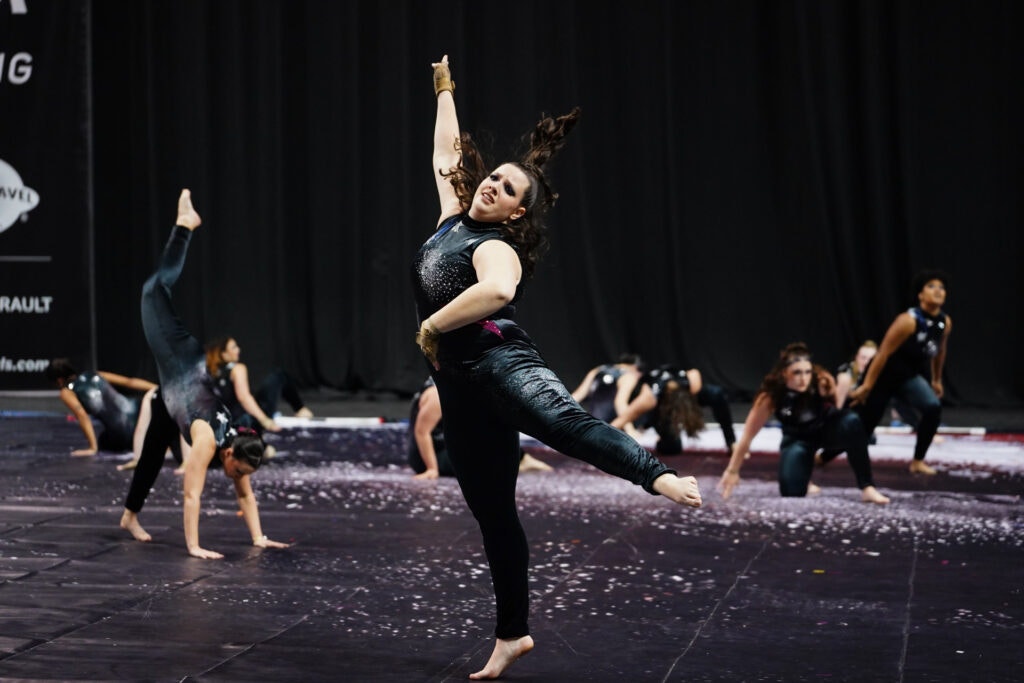
Lykins shared that many of her high school winter guard staff actively performed in independent groups while teaching her program, so she was aware of the option in front of her.
Asia Lovejoy, a rising sophomore winter guard member of Alta Marea, said despite feeling uncertain after high school, she knew she wanted to be a member of Alta Marea after seeing them perform for the first time.
“I told myself, ‘That’s where I want to go; that’s who I aspire to be,’” Lovejoy said.
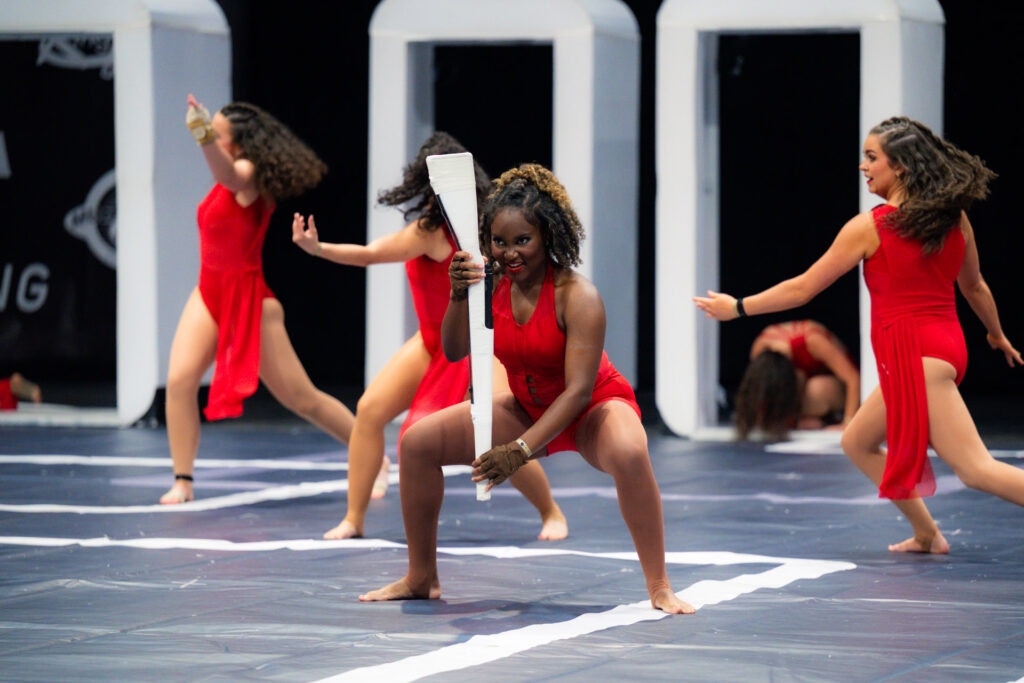
Alta Marea is a university group. All of its members are also members of The University of Alabama Million Dollar Band Color Guard. Lovejoy’s high school band director graduated from the University of Alabama, so their program incorporated a lot of the college colorguard mentality, Lovejoy said.
This made Lovejoy’s transition from high school to college guard much smoother than expected, she said.
For Lykins, her high school winter guard experience prepared her for college in interesting ways. Coming from a competitive high school program, she said she learned how to deal with people in stressful environments.
“In collegiate, there’s a lot of people and a lot of different personalities,” Lykins said. “I think having that exposure in high school with everyone else kind of made it more cohesive.”
Lykins said she knew not everyone would get along fully, but she felt more prepared to handle interpersonal conflicts because of her high school winter guard experience. At the end of the day, everyone wanted to see the program succeed, and having a common goal made gaining perspective easier, she said.
“You don’t have to be friends with your teammates, but you have to work with your teammates,” Lykins said.
In the percussion division, Satvik Katpadi took an unconventional route from high school to his independent career.
Katpadi studied at Penn State, participating in drum corps numerous times before deciding to audition for the George Mason University (GMU) Indoor Drumline, all the way in Fairfax, VA. Katpadi said he attended the first camp and knew immediately that he wanted to join.
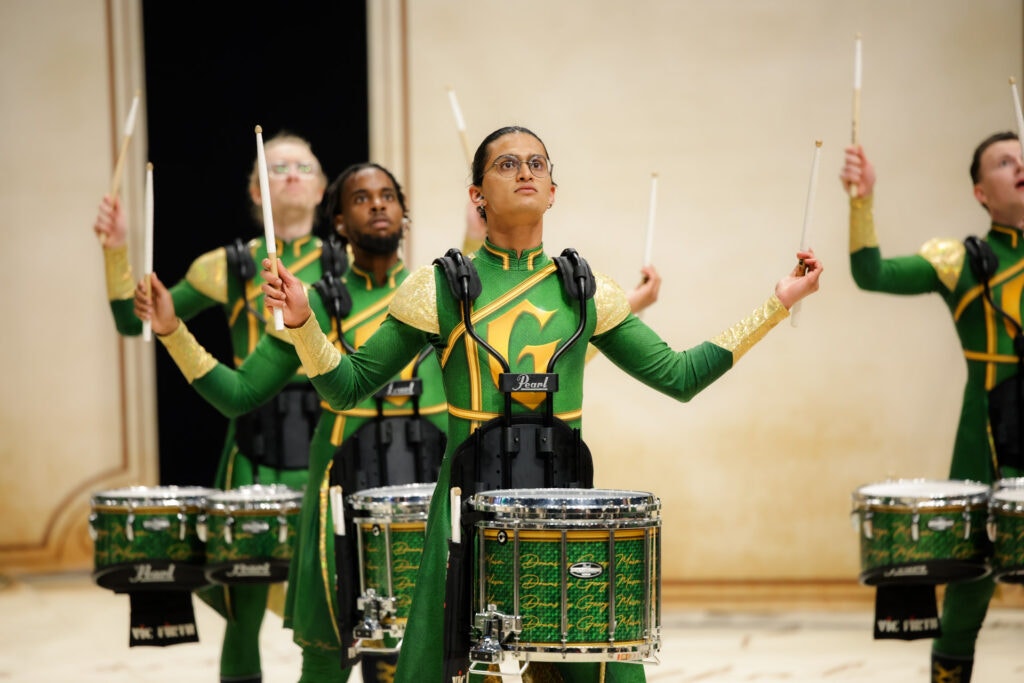
“The culture at George Mason and just the way they did it was like nothing else,” Katpadi said. “It kind of felt like the initial spark I had when I started indoor drumline in high school.”
Katpadi made the drumline, but living four hours away from where the program rehearsed required navigating a few tricky logistics before he could attend, Katpadi said.
He left his Friday class early, took a bus to Harrisburg, PA, and carpooled with friends the remainder of the way to GMU’s campus in Virginia.
“It was a lot to make happen at first, but I’m definitely really glad I made that happen,” Katpadi said.
Despite high school preparing the three performers for their college indoor marching arts careers, beginning something new comes with unique challenges. When asked about the biggest differences between high school and college indoor groups, Lykins, Lovejoy, and Katpadi shared stories about organization, pacing, and individual responsibility.
Rehearsals tend to be more frequent and run at a faster pace in college, the three shared. While their high school ensembles typically practiced two or three times a week, the performers’ college groups either rehearsed each evening of the week or took up most of their weekend hours.
“You had to pick up on drill faster, [choreography] faster, and just essentially know what you’re doing,” Lovejoy said, regarding college winterguard.
At the University of South Florida, rehearsals could last up to 12 hours, Lykins said. It became important to know how to pace herself, how to structure her time outside rehearsal, and how to make the most of breaks.
“You’ve kind of got to be more mentally prepared for it,” Lykins said.
For Katpadi, knowing he had a weekend full of drumline rehearsals ahead of him required preparation the week before, ensuring all homework, studying, and other commitments were completed.
“During the week, it’s kind of like a marathon to try and get everything in perfect order,” Katpadi said.
Despite all of the logistical planning that his busy schedule forced him to complete, Katpadi said he actually enjoyed the challenge. It was no longer possible for him to procrastinate, and his time management greatly improved because of it, he said.
Outside of rehearsal, one of the largest changes Lykins noticed after starting college was how much accountability she had for her schedule. Similar to Katpadi, she was structuring every minute of time to balance school and rehearsal.
“When you get to the independent level, you are trying to pay for your own things,” Lykins said. “You have to manage your own money. You also may need to get a job. No one’s going to sit you down and tell you to do your homework. So, you have to be responsible for that.”
Lykins also noted the difference in auditions between high school and college. At her high school, anyone interested was eligible to join, and the first day of auditions taught attendees how to do specific skills. In college, auditionees are assessed closely on technique, and begin learning choreography right away.
“You kind of just hit the ground running,” she said.
For Katpadi, the largest difference he noticed between high school and GMU was the members’ motivations for being in the ensemble.
“You happen to be competing oftentimes in the indoor drumline world, even in highschool; but, some people are there just to play drums and have fun,” Katpadi said. “Versus, independent indoor drumline, especially at the World Class level, everyone is there to compete.”
We asked Lykins, Lovejoy, and Katpadi what advice they have for anyone considering pursuing the indoor marching arts after high school. Here’s what they shared:
Alyssa Lykins: It does seem very scary and daunting at first, but honestly, everyone is there just to get better and continue to do the sport. If there’s people wanting to continue to do it, they’re in it for the long haul. So, everyone has the same goal as you. Go out, do your best, and everything else will work out the way it’s supposed to.
Asia Lovejoy: I would say my biggest thing is to just trust yourself and be confident. I feel like that’s the thing that got me through. I’m not going to show that I’m nervous and I’m scared that I think that I can’t do this. You just need to be confident and have that mentality that you can do anything. I did what I had to do, and it got me where I am now.
Satvik Katpadi: Just show up to auditions. Just showing up and talking to people and getting to know what the activity is really like at this different level and environment, kind of told me that I look up to these people. Don’t worry too much and just show up. People will help you and it will happen if you want it to happen.
Katpadi also noted the importance of seeking out help if cost is a concern. He shared that he worked a part-time job to support the cost of his dues and travel, and said that the staff encouraged participants to reach out with any financial concerns.
“I would not worry too much about the financial part of it,” Katpadi said. “Just try your best and be transparent if you’re struggling financially. There’s always people out there willing to help you.”
Katpadi said participating in the GMU drumline allowed him to experience a special kind of “goosebumps” feeling that he had only ever encountered in several of his favorite high school and drum corps performance run-throughs.
With GMU, however, he said he experienced that feeling every day in rehearsal. That feeling is largely why Katpadi said he encourages anyone on the fence about continuing to march to just go for it and see what happens—because he was in their shoes once.
“That’s the feeling of the people around you thinking and doing the same things as you and feeling the same things,” Katpadi said. “At the end of the season, you would feel like you could just read each other’s minds at times. It’s a really magical feeling.”
About the author:
Kellie Finch works as the Marketing and Communications Specialist for the North Carolina Center for the Advancement of Teaching. She graduated from the University of North Carolina at Chapel Hill with a bachelor’s degree in Media and Journalism and a minor in Music. Kellie participated in WGI winds all four years of high school, going on to become a member of the Marching Tar Heels in college.