By Michael Gaines
My relationship with Aimachi began in 1994, two years before we first brought the group to the United States to participate in WGI in 1996. Looking back, there is something fitting about 2016, exactly twenty years after that first appearance, becoming such a defining moment in both Aimachi’s history and the evolution of WGI Winds.
In 2014, Aimachi was invited to perform in exhibition at the WGI World Championships as the activity prepared to launch the Winds division. The goal was to show an example of what WGI winds COULD be. They performed several times over the Percussion Championship weekend and the WGI audiences gave them a wonderful reception. Two years later, in 2016, Aimachi returned, this time to compete in the very division they had helped inspire.
The show was titled Ascension, a concept centered on striving toward the highest level of artistic and performance achievement. That idea shaped every aspect of the production. From Jim Moore’s choreography to large, angled tower structures rising from the floor, with ramps and platforms that allowed performers to climb and perform at elevated heights. The staging itself became a metaphor. The floor design, set on a 100 by 70 canvas, and the costuming by Tommy Keenum created a layered visual environment that supported the idea of continual rise and growth.
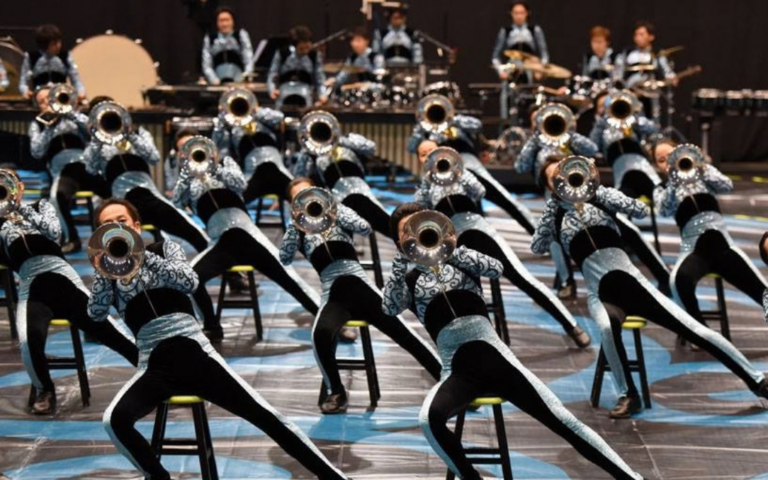
What made the 2016 season even more remarkable was the journey required to bring it to life. Aimachi had just completed their competitive marching band season in Japan, winning the All Japan Marching Band Contest in December 2015, their tenth championship. Within weeks, they began building an entirely new production for WGI. Without a competitive circuit to refine the show, they performed only a handful of times before traveling internationally with instruments, props, and an entire performance environment. The logistics alone were daunting.
There were also artistic expansions unique to WGI. Japanese marching band rules do not allow electronics or amplification, so Ascension marked one of the first opportunities for Aimachi to explore those elements. The production integrated a full soundscape, including a featured violin soloist, alongside brass, percussion, and winds. Kevin LeBoeuf helped shape a powerful and expressive brass program playing arrangements by Gordon Henderson. Because Aimachi does not traditionally use woodwinds, twelve guest woodwind performers joined the ensemble through the efforts of Uichi Kajiyama, a teacher at Meiden High School. Several of the performers were Meiden students, creating a collaboration that bridged not only programs, but cultures.
Musically, the show drew from a wide range of influences, including selections inspired by Final Fantasy and The House of Dancing Water, combined with original material and a featured cello duet. Visually and musically, the production became a synthesis of the WGI activity, blending the intensity of percussion, the artistry of color guard, and the depth of a winds ensemble into a single, unified voice.
On April 17, 2016, Aimachi won the WGI Winds International World Championship with a score of 97.450, becoming the first ensemble from outside the United States to win a WGI World Championship title. As one publication later observed, the group felt “two steps ahead of the activity,” a sentiment that reflected what many experienced in that moment.
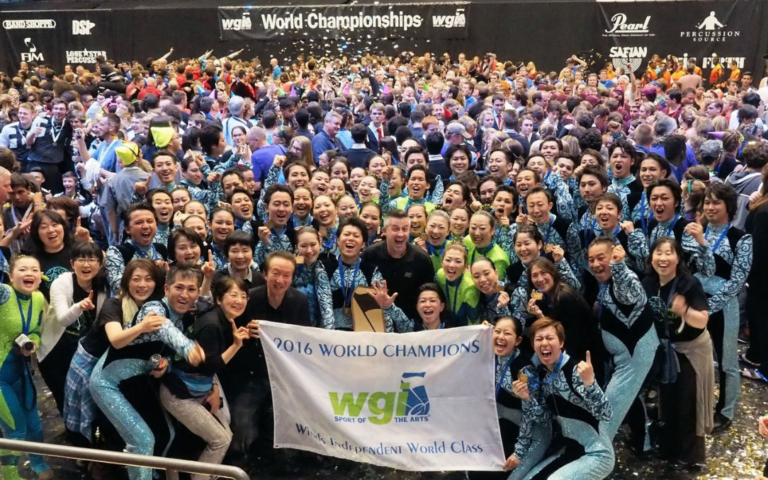
For me, Ascension represents more than a championship performance. It reflects decades of vision from Kiyokazu Sekine, who founded the group in 1962 with just four members, and a long-standing relationship between Aimachi and WGI that continued to grow over time.
In many ways, Aimachi was not simply participating in the Winds division in 2016, but helping define it in real time. It was not just about reaching the top. It was about expanding what the activity could be, and who it could belong to.