By Megan Doyle
WGI Percussion Judge Coordinator Chris Hestin has been making waves in the world of percussion adjudication for the past 25 years. From being a performer with the Phantom Regiment, a drum and bugle corps, in the late 80’s and early 90’s to taking on roles in percussion teaching and scoring later in life, his passion and efforts in the activity have led him to induction in the WGI Hall of Fame. The WGI community is honored to introduce Hestin to the notable group of trailblazers in the largest circuit for pageantry arts.
Hestin describes his commitment to his career beginning with his first experiences judging.
“After college, when WGI began to take off, I was aware of the new percussion division within WGI, but my first real exposure was when I began judging,” he says. His career in judging began with his experiences in other circuits.
“It would have been late 1999 living in Pittsburgh. Some friends were recruiting judges for the Ohio indoor circuit, [the Mid East Performance Association (MEPA)], where they’ve been judging and coordinating. Back then, there was a parallel judges association, MEJA, the Mid East Judges Association. They provided judges for MEPA. They asked if I’d be interested. Of course, I was!”

He was consistently drawn to the activity by its dynamic nature, constant evolution, and the cultivation of relationships with like-minded individuals.
“Already being kind of busy with designing and teaching in the fall during the school year, and then during the summer, what initially kept me committed was just the thrill of being part of something so dynamic, so exciting, and just being able to keep my finger on the pulse of the most cutting edge aspects of pageantry, and really how that helped reinforce my own teaching, writing, and designing,” he says. “From there, I think all of the relationships that have been fostered over time really cemented my commitment to the activity and its health and growth.”
From his first experience being a MEPA judge, Hestin worked his way up over the years serving in various circuit judge administration roles to eventually working for WGI as a percussion judge and then becoming the percussion judge coordinator in 2012.
Hestin’s experience being the percussion judge coordinator has been formative for him personally and professionally. He notes that over the past 15 years of being in this role, one of the most important parts was the relationships he fostered.
“I think my favorite part of the role has been the cultivation of relationships, both within the percussion adjudication team and the benefits that come when someone is empowered and supported by colleagues, but really also the relationship between the adjudicators and hen the instructors, designers and staff just working to create that culture of trust.”
Hestin emphasizes that another one of his favorite parts about the activity is its dynamic nature, and he has observed a lot of change over the course of his 15-year career being percussion judge coordinator.
“I think the most notable evolution of percussion adjudication really has just been the judges on the whole committing to being better at their craft,” he says. “This would include really internalizing the philosophy of adjudication, continually working to better understand their caption, broadening their awareness with support from other disciplines, and using colleagues for enhancement and motivations within their own awareness and approach.”
This commitment to honing one’s skills at adjudication is one of the values Hestin possesses that left a mark on WGI history. His Hall of Fame induction left a significant mark on him personally and professionally.
Hestin found out about his nomination late one Wednesday night after a percussion administration call.
“I didn’t black out, but I may have whited out a bit. I was completely blindsided. Certainly not what I was expecting to hear at 11 pm that night, so I was pretty shocked,” he says.
“But as for what it means to me personally, I think all the obvious feelings when such an honor is bestowed, I guess it personally somewhat validates my choice to long ago pivot out of finance as a bank trader to a career in music. It resonates deeply within me that for the performers, the staff, my colleagues, and the art form, that my genuine care and compassion seem to have made a difference.”
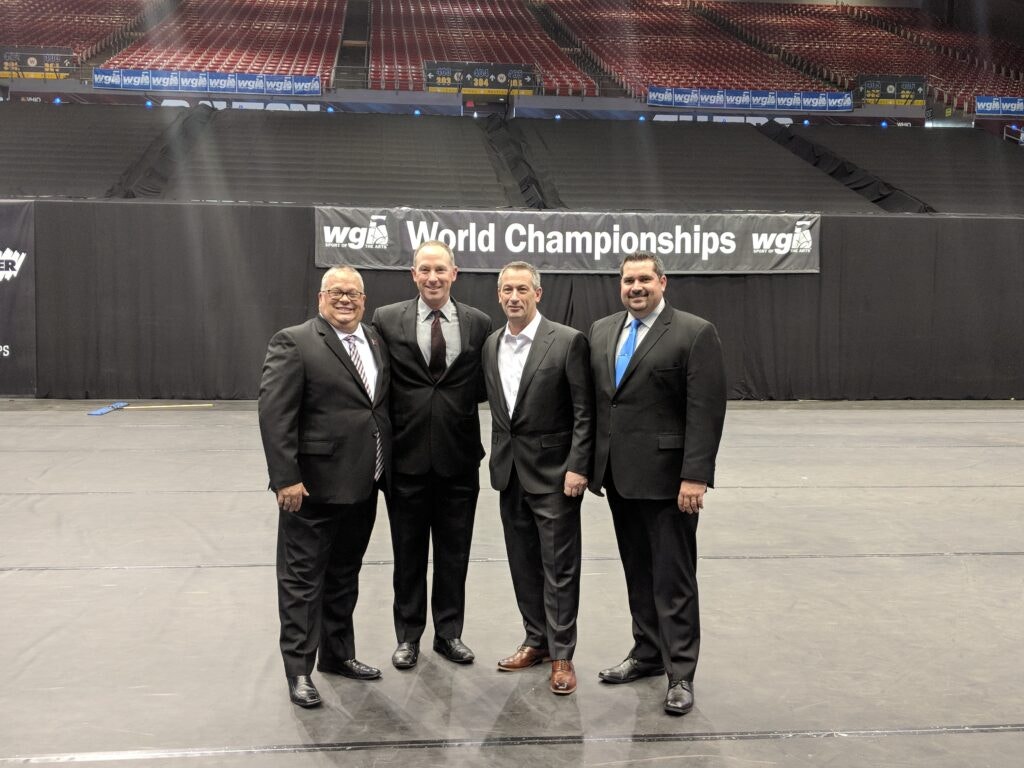
The level of commitment to the activity Hestin demonstrated during his career with WGI did not go unnoticed, and his induction to the Hall of Fame is a well-deserved addition to his long list of accomplishments in the activity.
As the activity continues to grow, Hestin is eager to see just how far it goes and what levels performers, designers, and adjudicators can reach.
“I think I’m most excited that the system is set up for explosive growth, both in the numbers or participants and in the level of performance, quality, and creativity,” he says. “There’s a place for every performer, every instructor, composer, choreographer, designer, to maximize their experience in this amazing activity.”
Chris Hestin’s nomination for the WGI Hall of Fame means a lot to him, his colleagues, and the ensembles that have stood in front of him since the day he began his career. It is reflective of the community he has found with WGI, his passion for the activity, and his excitement for the future of percussion performance.
About the Author:
Megan Doyle is a freelance feature writer for WGI Sport of the Arts, telling stories that highlight the people, passion, and performance behind the activity. Based in Dayton, Ohio, she focuses on thoughtful pieces that capture the heart of the marching arts community.